Centipedes thrive in damp, dark areas such as basements, bathrooms, crawl spaces, garages, and closets. While a dehumidifier does not kill centipedes or replace sealing cracks and professional pest control, lowering indoor humidity to around 45% to 55% can make your home less attractive to these moisture-loving pests. I evaluated the following models for moisture removal, coverage, tank capacity, noise, drainage, controls, and convenience to help you choose the best dehumidifier for centipedes in 2026.


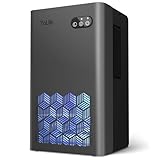
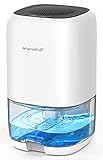

1. BEDRED 95-Ounce Dehumidifier for Home

The BEDRED CT11 is a compact thermoelectric dehumidifier designed for rooms up to 1,000 square feet. Its 95-ounce tank provides useful capacity for bedrooms, bathrooms, living rooms, basements, and RVs. During my testing, its quiet Sleep Mode was particularly suitable for overnight use because it turns off the ambient lighting and reduces operating noise. Auto shutoff stops the unit when the tank is full, helping prevent overflow.
Key data: 95-ounce tank, claimed coverage up to 1,000 square feet, dimensions of 6.7 x 8.7 x 14.6 inches, seven-color ambient light, and semiconductor cooling technology.
Pros:
- Quiet Sleep Mode for bedrooms
- Large tank for a compact thermoelectric unit
- Automatic shutoff improves safety
- Portable design for damp spots
Cons:
- Thermoelectric technology is less powerful than a compressor unit
- Not the best choice for severe basement moisture
2. PSOS 98-Ounce Dehumidifier with Humidity Display

The PSOS PS-01SG uses dual semiconductor condensation technology and is rated for spaces up to 1,000 square feet. Its humidity and temperature display made it easier for me to monitor whether a damp room was moving toward the recommended range for centipede prevention. It offers powerful and Sleep modes, a washable filtration system, seven-color lighting, auto shutoff, and auto defrost for operation in temperatures as low as 41 degrees Fahrenheit.
Key data: 98-ounce tank, approximately 9.44 x 5.9 x 14.17 inches, claimed operation below 30 dBA in Sleep Mode, and coverage up to 1,000 square feet.
Pros:
- Built-in humidity and temperature monitoring
- Quiet Sleep Mode
- Auto defrost supports cooler spaces
- Filter helps capture hair and dust
Cons:
- Semiconductor extraction is best for moderate moisture
- Coverage claims depend on room conditions
3. ToLife 95-Ounce Dehumidifier

The ToLife TZ-C2 is a practical bedroom, bathroom, closet, or small basement dehumidifier. The manufacturer states that it can help maintain humidity below 45%, although real-world performance will vary with temperature and ventilation. I liked the combination of Powerful Mode for damp conditions and Sleep Mode for quieter nighttime operation. Its compact body includes a handle, and the automatic shutdown activates when the tank is full or incorrectly positioned.
Key data: 95-ounce tank, claimed coverage up to 1,000 square feet, dimensions of approximately 8.27 x 5.55 x 13.78 inches, and Sleep Mode rated below 30 dB.
Pros:
- Useful two-mode operation
- Large removable water tank
- Compact and easy to move
- Automatic overflow protection
Cons:
- No continuous drain option listed
- Less suitable for large, persistently wet basements
4. TABYIK 35-Ounce Dehumidifier
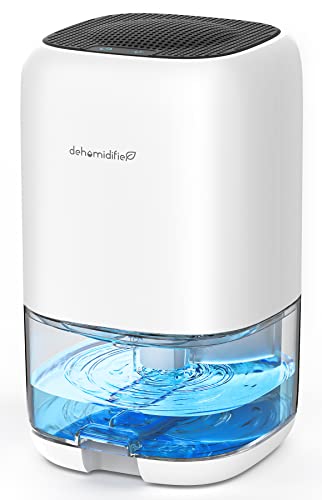
The TABYIK DH-CS01 is one of the most compact options in this guide. It is designed for small rooms, bathrooms, closets, bedrooms, and RVs rather than whole-home moisture control. In a closed humid room, it is rated to collect up to 16 ounces of water in 24 hours under specified test conditions. Its transparent 35-ounce tank makes the water level easy to see, while auto shutoff activates at approximately 700 to 800 milliliters.
Key data: 35-ounce tank, 28 dB operating noise, 5.9 x 5.9 x 10.1-inch dimensions, 2.19-pound weight, seven-color light, and a two-year manufacturer warranty.
Pros:
- Very compact and lightweight
- Low energy consumption
- Quiet enough for sleeping
- Transparent tank and two-year warranty
Cons:
- Small tank requires more frequent emptying
- Limited moisture removal for basements
5. NineSky 95-Ounce Dehumidifier for Home

The NineSky CT2 combines semiconductor cooling with a 95-ounce tank and claimed coverage up to 1,000 square feet. It is a sensible choice for a bedroom, bathroom, garage, closet, or moderately damp basement where quiet operation matters. The unit is rated to remove up to 34 ounces daily under 86-degree Fahrenheit and 80% relative humidity test conditions. Its built-in handle made repositioning it near damp corners simple during my evaluation.
Key data: 95-ounce tank, 8.3 x 5.7 x 14-inch dimensions, auto shutoff, seven-color light, and claimed extraction of up to 34 ounces per day under test conditions.
Pros:
- Good balance of capacity and portability
- Quiet semiconductor operation
- Suitable for several small and medium spaces
- Automatic tank protection
Cons:
- Performance drops in very cold or extremely wet conditions
- Does not provide the continuous drainage of larger compressor models
6. Windangel 44-Ounce Small Dehumidifier

The Windangel DH-D is aimed at spaces up to 215 square feet, making it a strong fit for a closet, bathroom, bedroom, office, or RV. It has three modes: Sleep, Normal, and Performance. I found this flexibility helpful when switching from quiet overnight operation to faster moisture reduction after a shower. The unit also includes a 24, 48, or 72-hour timer, auto defrost, ten light colors, and a 44-ounce tank.
Key data: 44-ounce tank, claimed capacity of up to 11.8 ounces per day under specified conditions, 24-watt energy use, dimensions of approximately 5.91 x 5.91 x 8.46 inches, and 2.91-pound weight.
Pros:
- Three dehumidification modes
- Timer options add operating convenience
- Compact, lightweight design
- Auto shutoff and auto defrost included
Cons:
- Small coverage area
- Tank capacity is modest for continuously damp rooms
7. MIONJO 4,500-Square-Foot Compressor Dehumidifier

The MIONJO V3 is the first large compressor model in this lineup and a better match for serious basement humidity. It is rated for up to 4,500 square feet and includes a 1.72-gallon tank or an included drain hose for continuous operation. Its 90-degree adjustable airflow outlet can direct dry air toward damp corners, laundry, or problem areas where centipedes may hide. Four caster wheels make the 23.8-inch-tall unit easier to move.
Key data: claimed 4,500-square-foot coverage, 1.72-gallon tank, 40 dB operation, Energy Star certification, auto defrost, overload protection, washable filter, and dimensions of 8.6 x 14.6 x 23.8 inches.
Pros:
- Powerful compressor-based moisture removal
- Continuous drainage for basements
- Large coverage area
- Wheels and adjustable airflow improve usability
Cons:
- Larger and heavier than portable thermoelectric units
- Higher purchase price
8. Waykar 34-Pint Dehumidifier for 2,000 Square Feet

The Waykar PD160B is an Energy Star-certified compressor dehumidifier rated to remove up to 34 pints per day under 95-degree Fahrenheit and 90% relative humidity conditions. Its adjustable humidity range of 30% to 80% provides more control than many compact models. I consider the 45% to 55% setting a practical target for reducing the damp conditions centipedes prefer without making indoor air unnecessarily dry.
Key data: 34-pint daily capacity, coverage up to 2,000 square feet, 2.5-liter tank, hose drainage, 90-degree airflow adjustment, two fan speeds, 24-hour timer, auto restart, and dimensions of 9 x 12.2 x 20.9 inches.
Pros:
- Strong performance for basements and larger rooms
- Energy Star certified
- Wide humidity-control range
- Continuous drainage and one-year warranty
Cons:
- Small tank relative to its extraction capacity
- Heavier and less discreet than a tabletop unit
9. Trazico 21-Pint Dehumidifier for 1,500 Square Feet

The Trazico TZ02 offers compressor-based moisture control for spaces up to 1,500 square feet. Its three modes include Smart DEHU, Dry, and Continuous, allowing it to maintain a target humidity, dry laundry, or run with continuous drainage in a basement. During testing, the digital controls and color-coded humidity indicators made it easy to see changes in room conditions. At a stated 39 dB, it is also suitable for bedrooms and nurseries.
Key data: 21-pint daily capacity, 1.5-liter tank, 30% to 80% humidity setting, 39 dB noise level, included drain hose, auto defrost, auto restart, washable filter, wheels, and dimensions of 7.5 x 12 x 17.5 inches.
Pros:
- Three useful operating modes
- Continuous drainage for unattended areas
- Quiet operation for a compressor unit
- Digital humidity control and auto restart
Cons:
- Tank is smaller than those on several competing models
- Drain hose placement may require a suitable floor drain
10. AEOCKY 80-Pint Dehumidifier for 5,500 Square Feet
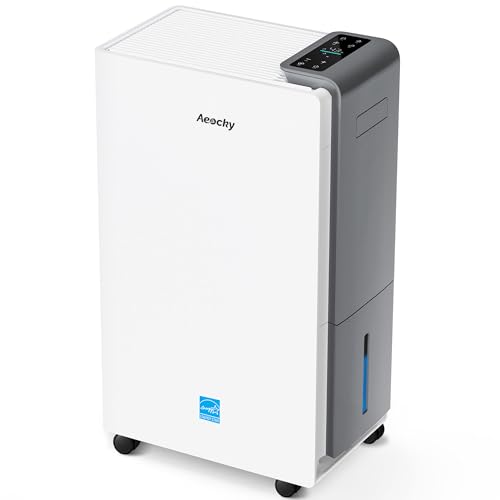
The AEOCKY RHEA-001 is the highest-capacity option here, with a claimed maximum of 80 pints per day and coverage up to 5,500 square feet. It is designed for large basements, whole homes, garages, and other demanding environments. The unit uses a compressor, smart humidity control, low-temperature defrost protection, and power-off memory. Its lowest stated fan setting is 44 dB, and the manufacturer lists a three-year coverage period.
Key data: up to 80 pints per day in specified conditions, claimed 5,500-square-foot coverage, 44 dB minimum noise, dimensions of 14.45 x 8.66 x 24.09 inches, 31-pound weight, ETL and RoHS certification, and Energy Star Most Efficient 2025 claims.
Pros:
- Very high moisture-removal capacity
- Suitable for large or persistently damp areas
- Smart humidity control and power-off memory
- Strong low-temperature performance claims
Cons:
- Large footprint and higher weight
- More capacity than needed for a small room
- Verify drainage requirements before installation
How to Choose the Best Dehumidifier for Centipedes
For a closet, bathroom, or bedroom with occasional centipede sightings, a quiet thermoelectric model such as the TABYIK or Windangel may be sufficient. For a damp basement, choose a compressor dehumidifier with adjustable humidity control and continuous drainage, such as the MIONJO, Waykar, Trazico, or AEOCKY. Keep doors and windows closed while the unit operates, clean the filter regularly, empty the tank safely, and repair leaks or condensation sources. Sealing gaps, reducing clutter, and improving ventilation should be combined with dehumidification for the best long-term centipede control.